"Why did we choose React?" should have an answer
Engineering teams make dozens of technical decisions every quarter. Most of them live in someone's head or a chat thread from 6 months ago. DecTrack gives your team a place to evaluate, decide, and document technical choices.


The Problem
Technical decisions with no paper trail
Your team chose Angular over React two years ago. A new developer asks why. Nobody remembers the full reasoning. The CTO has a vague recollection. The original decision was made in a meeting that wasn't documented.
Decisions that vanish after the meeting
Your team agrees on improvements: "Let's change our code review process." "Let's switch to trunk-based development." Two sprints later, nobody followed through. The same items come up again. There's no place where the decision was captured.
Senior voices dominate, junior input gets lost
In technical discussions, the most senior person's opinion often wins by default. Junior developers hold back. The team misses perspectives that could have prevented a bad choice.
How DecTrack Helps
Structured technical evaluations
Create a decision for your tech stack choice, migration plan, or architecture change. Add a Pro/Con list or SWOT analysis. The team evaluates async. When it's done, the reasoning is documented. Next year, when someone asks "why?", the answer is right there.
Capture improvements instead of forgetting them
When your team agrees on improvements, create them as decisions in DecTrack. The team evaluates what to prioritize. Set a deadline. Assign an owner. Each improvement gets a clear framework and a documented outcome.
Anonymous voting levels the playing field
DecTrack supports anonymous voting. Juniors can share their honest assessment without worrying about contradicting the tech lead. You get the full team's perspective, not just the loudest voices.
A Real Scenario
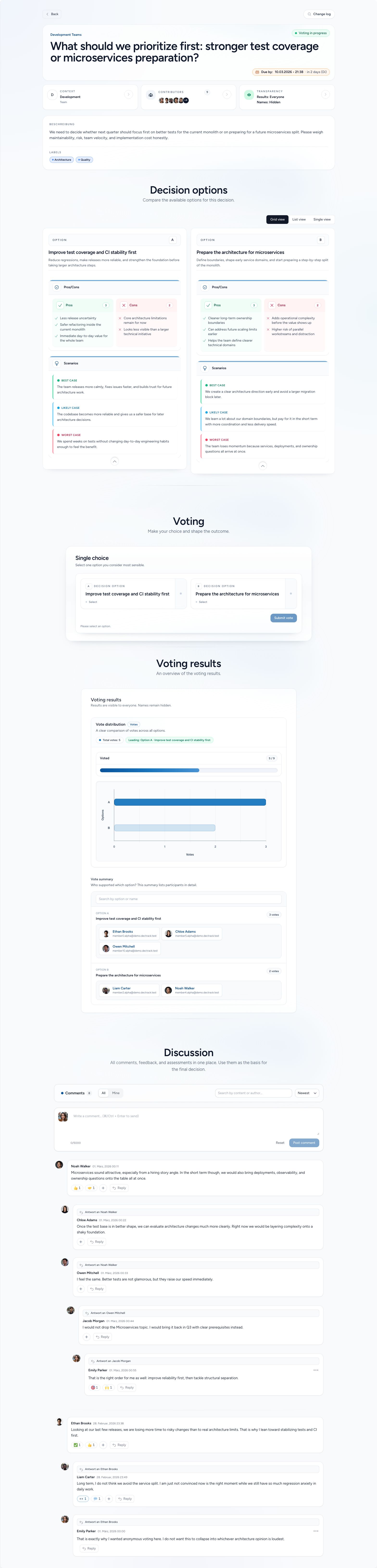
Your team needs to decide: migrate the monolith to microservices now, or invest in better testing for the existing codebase? The CTO leans toward microservices. Two senior devs disagree. The juniors aren't saying much.
You set up a decision in DecTrack with both options. You add a Pro/Con analysis: maintenance cost, team velocity, risk of regression, hiring implications. Everyone scores both options over two days. Voting is anonymous.
The results surprise you. The microservices option scores high on "long-term maintainability" but poorly on "team velocity next 6 months" and "risk." The juniors flagged risks that seniors hadn't considered. The team decides to improve testing first, revisit microservices in Q3. The decision, including all the trade-offs, is documented. When the Q3 discussion comes, they start from where they left off.
Key Features for Engineering Teams
Pro/Con and SWOT analysis
Evaluate technical options with structured frameworks. Not just "I think React is better" but documented reasoning.
Anonymous voting
Remove seniority bias in voting. If an approver decides differently, the reason gets documented.
Decision archive
Searchable log of every technical decision. Filter by project, tag, or timeframe. Onboard new developers faster.
Deadline tracking
Technical decisions don't drift. Set a deadline, get notified, close it out.
Project organization
Group decisions by project, sprint, or technical domain. Keep your monolith migration decisions separate from your CI/CD pipeline choices.
What Changes
New developers onboard faster. They read the decision log instead of asking "why did we pick this framework?"
Improvements actually happen. They're tracked, assigned, and closed.
Technical debates have structure. Instead of the loudest voice winning, the team evaluates against criteria.
Your CTO can justify technical investments to management. The reasoning is documented and shareable.
Your next technical decision, traceable
Free to start. No setup overhead. Your team can start evaluating options today.
DecTrack is in Early Access. Built for engineering teams that want to bring the same rigor to their decisions that they put into their code. Try it free.