How to Reduce Meetings by Making Better Decisions
Most meeting overload is a decision problem in disguise. Learn how documenting decisions, making them findable, and assigning clear owners eliminates unnecessary meetings.
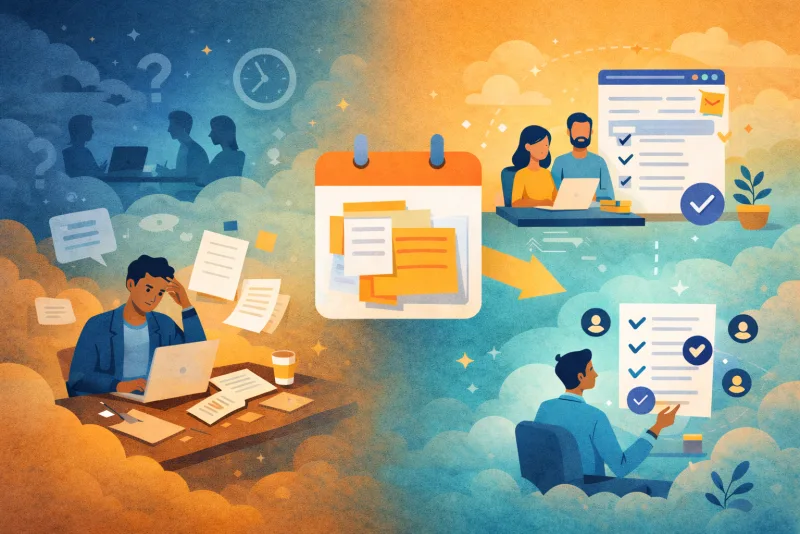
Most teams have tried the standard fixes for meeting overload. Shorter time slots, stricter agendas, "this meeting could have been an email" as a mantra. These are useful practices, and they do make a difference at the margins.
But if your calendar still feels packed after trying all of that, the issue might not be how you run your meetings. It might be why so many of them exist in the first place.
Research from Atlassian's 2024 workplace study found that 72% of meetings fail to effectively accomplish their goals, and 78% of employees say the volume of meetings prevents them from doing their actual work. These numbers suggest the problem goes deeper than meeting hygiene. A big part of the reason teams have too many meetings is that previous decisions were not captured in a way that is visible, clear, and findable. When decisions are documented well, a large chunk of "alignment" and "update" meetings simply stops being necessary.
This article explores how decision quality connects to meeting volume, and what teams can do about it.
Free tool for this article:
→ Free Meeting Cost Calculator – Find out what your meetings really cost
The Usual Meeting Advice (And Why It Only Goes So Far)
The standard recommendations for reducing meetings are well-known by now: set a clear agenda before every meeting, keep it short (25 minutes instead of 30 or 60), only invite people who need to be there, end with clear action items, and cancel recurring meetings that no longer serve a purpose.
This is all solid advice. Teams that follow it consistently will have better meetings. No question.
Where it falls short is when a team implements all of these tips and still finds itself spending 10 or more hours a week in meetings. That usually points to a structural issue that no amount of agenda discipline can fix. The meetings keep happening because the team needs to re-discuss, re-align, or re-decide things that were already covered before but were never captured in a way that stuck. This pattern is often called meetingitis, a symptom of weak decision design.
The average employee now spends 11.3 hours per week in meetings (Fellow, 2024). That is close to a third of the workweek. And when Atlassian surveyed workers, 54% said they leave meetings without knowing what to do next. This is not a scheduling problem. It is a decision problem wearing a calendar disguise.
The Connection Between Decisions and Meetings
Think about the last meeting that felt unnecessary. Chances are it fell into one of these categories:
A decision that already happened but was not written down. The team made a choice three weeks ago, maybe during a call or in a Slack thread. But nobody documented it in a way that is easy to find. So now the meeting is about "getting aligned," which often turns into re-making the same decision.
Someone who was not present for the original conversation. They need to catch up. Instead of reading a two-paragraph decision record (which does not exist), they ask for a 30-minute meeting with three people to understand what was decided and why.
A decision that was vague. The team agreed on a direction but not on the details. Three people left with three different interpretations of what "we decided." A week later, the misalignment surfaces, and another meeting gets booked to sort it out.
A discussion without a clear decision owner. Everybody weighed in, the options were discussed at length, but nobody was designated to make the final call. So the topic rolls over to the next meeting. And the one after that.
Each of these is a decision problem that manifests as a meeting. The meeting is not the cause. It is the response to a decision that was either not made, not captured, or not clear enough.
For teams that notice this pattern frequently, it often reflects a buildup of decision debt: undocumented or unclear past decisions that slow everything down and pull people back into discussions they thought were already settled.
Five Types of Meetings and What Is Really Behind Them
It can be helpful to look at recurring meetings through the lens of decision quality. This table maps common meeting types to the decision issue that often drives them:
| Meeting Type | What People Say | What Is Often Really Going On |
|---|---|---|
| Status update | "Where are we on this?" | There is no shared, visible place to check progress or past decisions |
| Alignment meeting | "Let's make sure we're on the same page" | A previous decision was not documented clearly enough for everyone to act on it |
| Re-decision meeting | "Didn't we already discuss this?" | The decision was made but never recorded, or someone new is questioning it without seeing the original reasoning |
| Escalation meeting | "We need someone senior to make a call" | Decision authority was never defined, so the group circles without resolution |
| Information share | "I need to update the team" | Could often be a written update, a short recorded video, or a post in a shared channel |
Not all of these are unnecessary. Status updates and alignment meetings can be valuable when they are focused. But when they keep recurring on the same topics, the underlying issue is usually that a past decision was not visible or clear enough to prevent the re-discussion.
Shopify made a bold move on this front in 2023 when they canceled 12,000 recurring meetings across the company. The outcome was not confusion. It was a projected 25% increase in completed projects. They did not stop talking to each other. They just shifted from verbal re-alignment to written, visible decisions that people could reference on their own time.
Three Changes That Reduce Meetings at the Root
Agendas and time limits help you run better meetings. The three practices below help you need fewer of them.
1. Document every significant decision
When a decision is written down, with what was decided, why, by whom, and what alternatives were considered, it does not need to be re-discussed. A new team member can read the record instead of requesting a catch-up meeting. A colleague who missed the original conversation can check the log instead of asking three people for their version of what happened.
This alone makes a noticeable difference. The information that would have been shared verbally in a 30-minute alignment call is already written down and accessible. People read it when they need it, at their own pace, without blocking anyone else's time.
2. Make decisions findable
A decision that is buried in paragraph four of meeting notes, or lost in a chat thread, or sitting in someone's personal Notion page is effectively undocumented. For decision records to reduce meetings, they need to be in a place where anyone on the team can search and find them quickly.
"Payment provider decision" typed into a search bar should return the decision, the rationale, and the owner within seconds. If your team has to ask around or scroll through old files to find that information, the record is not doing its job yet.
3. Assign decision owners
Many recurring meetings exist because nobody has the authority to simply make a decision. The group discusses, weighs options, and then schedules another session to "finalize." This cycle can drag on for weeks.
Clear decision ownership changes this. The owner gathers input (which can happen asynchronously), makes the call, documents the reasoning, and shares it. The team reviews in writing and raises concerns if they have them. No meeting needed for the final step.
This connects to the broader question of when a group decision is necessary versus when a single owner should decide. Not every choice needs full consensus. Many need one well-informed person with clear authority and a solid process for gathering input.
The Meetings Worth Keeping
Reducing meetings does not mean eliminating all of them. Some meetings are valuable precisely because they bring people together in real time. The goal is to protect those meetings by removing the ones that do not need to happen.
Meetings where complex decisions need live debate. When the trade-offs are significant and the team benefits from hearing each other's reasoning in real time, a meeting is the right format. The key is that these meetings end with a documented decision. A good discussion that does not result in a recorded outcome will likely generate another meeting downstream.
Creative and strategic sessions. Brainstorming, quarterly planning, retrospectives. These work best when people can build on each other's thinking in the moment. The energy of a good collaborative session is hard to replicate asynchronously.
One-on-ones. Coaching conversations, career development, feedback, relationship building. No amount of documentation or tooling replaces the value of a direct, personal conversation between two people who work together closely.
Team rituals that build trust. Weekly standups, team check-ins, informal coffee chats. If they keep the team connected and cost less than 30 minutes, they are usually worth keeping even if they do not always produce a "decision."
A useful test after any meeting: did it produce a decision, a creative breakthrough, or a stronger relationship? If the answer is yes to any of those, the meeting earned its time. If the answer is none of the above, it is worth asking whether the same outcome could have been reached asynchronously.
A Week-by-Week Plan for Fewer, Better Meetings
Here is a practical approach that a team can start without any new tools or a big rollout.
Week 1: Audit your calendar. Look at every meeting from the past week and sort them into three buckets: "produced a decision," "shared information," and "no clear outcome." Count each bucket. Most teams are surprised by how few meetings actually produce decisions.
Week 2: Replace two information meetings. Pick two recurring meetings that are mostly about sharing updates. Cancel them and replace each with an async alternative: a written update in a shared channel, a short recorded video, or a weekly summary document. Tell the team why and ask for feedback after a week.
Week 3: Start a decision log. Begin capturing significant decisions in one shared place. It can be a simple document, a database in Notion or Confluence, or a dedicated tool like DecTrack. What matters is that it exists, the team knows where it is, and decisions go in there consistently. From now on, when someone asks "didn't we already discuss this?", the answer is a link, not another meeting.
Week 4: Introduce the pre-meeting check. Before scheduling any new meeting, check: has this already been decided? Is there a record? If yes, share the link instead of booking the room. If no and a decision is needed, consider whether it can be handled with an asynchronous decision process or whether it truly needs a live conversation.
Teams that stick with these four steps tend to notice a real difference within a month. Not because they stopped collaborating, but because collaboration shifted from repetitive verbal re-alignment to structured, written decisions that everyone can access when they need them.
What This Looks Like in Practice
A product team at a mid-size company had 14 recurring weekly meetings on their calendar. After running the audit in Week 1, they found that 5 of those meetings were pure information sharing (sprint updates, cross-team status reports) and 3 rarely produced any outcome.
They replaced the 5 information meetings with async written updates. They canceled 2 of the 3 low-outcome meetings entirely (nobody noticed they were gone). The third they kept but shortened to 15 minutes with a focused decision agenda.
They started a simple decision log in a shared Notion database. Within three weeks, the first "didn't we already decide this?" moment happened, and the team lead responded with a link to the decision record. The discussion that would have taken 20 minutes was resolved in 30 seconds.
The end result: 7 fewer recurring meetings per week. Roughly 8 hours of meeting time freed up across the team. And the meetings that remained were more focused because people came prepared, knowing that the outcomes would be documented and visible.
FAQ
How many meetings per week is too many?
There is no universal number, but research points to about 10 hours per week as a tipping point where productivity starts to drop noticeably. If your team regularly cannot finish their actual work because of meeting load, the quantity needs to come down. The goal is not zero meetings. It is making sure that every meeting that does happen earns its place on the calendar.
Will fewer meetings make people feel disconnected?
This is a common concern, and it is worth taking seriously. The answer depends on what you replace meetings with. If you just cancel meetings without offering an alternative way to stay informed, people will feel left out. But if you replace them with visible decision records, written updates, and a searchable shared log, most people actually feel more included. They can access the same information without needing to be in a specific room at a specific time.
What is the fastest thing we can do this week?
Cancel one recurring meeting that has not produced a decision in the last month. Replace it with a shared document or channel where the same information is posted asynchronously. If nobody notices it is gone after two weeks, it was not needed. If people do miss it, you can always bring it back in a shorter format.
Do we need a special tool, or is a spreadsheet enough?
Start with whatever your team will actually use. A Google Sheet with columns for decision, date, owner, and rationale is a perfectly fine starting point. If decisions start piling up and become hard to search, or if you want the team to collaborate on evaluating options before making a call, a purpose-built tool like DecTrack can help. But the habit of capturing decisions matters much more than the tool you use to do it.
Which meetings should never be canceled?
One-on-ones, retrospectives, and meetings where complex decisions need live debate. These benefit from real-time interaction and the human nuance that async communication cannot fully provide. If a meeting involves coaching, conflict resolution, or high-stakes trade-offs, it belongs on the calendar.
Our leadership is the one scheduling most of the meetings. How do we change things from within?
Start with your own team. Document your decisions visibly, reduce your own recurring meetings, and track the results. When leadership sees a team moving faster with fewer meetings and clearer decision records, the approach tends to spread. Meeting culture shifts almost always start with one team that demonstrates it works, not with a top-down policy change.
DecTrack
8. March 2026