Too Many Meetings? Why "Meetingitis" Is a Decision-Design Problem
Meetings multiply because decisions are not made or documented. A research-backed framework for shifting from meeting-centric to decision-centric teams.
"Too many meetings."
When knowledge workers are asked to identify the primary barrier to productive work, this response arises with remarkable consistency. Across multiple workplace surveys and organizational studies, meetings are cited as the single greatest impediment to productivity in contemporary organizations.
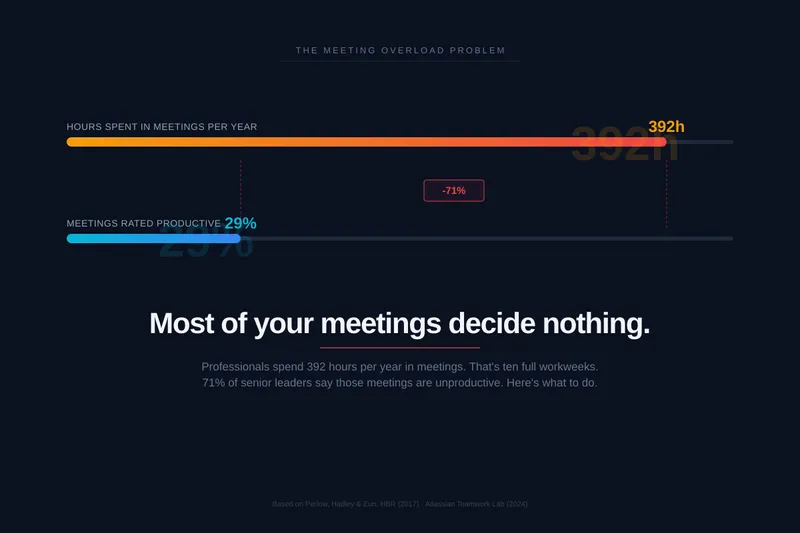
The data substantiate this claim. The average employee now spends over 11 hours per week in meetings, approximately one-third of the standard workweek. Across a full year, this translates to roughly 392 hours, the equivalent of nearly ten full workweeks devoted to meetings. Among executives and senior managers, the figure is substantially higher, with some reporting nearly 23 hours per week in meetings.
Despite this considerable investment of organizational time, the outcomes are frequently insufficient. Research indicates that 71% of senior leaders consider their meetings unproductive, and 54% of professionals leave meetings unclear about next steps or ownership.
This phenomenon has been termed Meetingitis: the systematic proliferation of meetings beyond the point of productive return.
Conventional productivity advice tends to address the symptom rather than the underlying cause. Recommendations such as "no-meeting days," shorter time slots, or calendar-blocking techniques offer tactical relief but fail to address the structural dynamics driving meeting proliferation.
This article argues that meetings multiply primarily because decisions are either not being made or not being documented. When organizations lack structured decision processes, meetings become the default mechanism for coordination, discussion, and ambiguity resolution. Rather than advancing work, they function as placeholders for unresolved decisions.
- Unclear or absent decision processes lead to additional meetings.
- Additional meetings generate more discussion without resolution.
- Unresolved discussions necessitate further meetings.
Breaking this cycle requires shifting organizational attention from meetings as a unit of coordination to decisions as the unit of progress.
Free tool for this article:
→ Free Meeting Cost Calculator – Find out what your meetings really cost
The Proliferation of Meetings in Modern Organizations
Understanding why meetings proliferate requires examining the structural evolution of knowledge work.
Contemporary organizations depend on coordination among multiple individuals, teams, and functional areas. As organizational complexity increases, meetings often become the most accessible mechanism for aligning information across stakeholders.
The scale of this trend is significant. Research indicates that the total time spent in meetings has more than doubled since the 1960s, with the most pronounced increases among managers and senior professionals. In many organizations, employees now attend three or more meetings per day, fragmenting the workday into short intervals of discussion rather than sustained periods of focused work.
The rise of hybrid and remote work has amplified this dynamic. Virtual meeting platforms reduce the friction of scheduling to near zero. Instead of composing a written summary or walking to a colleague's desk, the default response to uncertainty has increasingly become a video call.
This convenience introduces a structural paradox: meetings facilitate coordination, yet excessive meetings consume the cognitive resources and time required to perform the work being coordinated.
Researchers describe this as the meeting load paradox: as meeting frequency increases, employees initially gain more opportunities to contribute and align with colleagues; however, beyond a critical threshold, the cumulative meeting load begins to erode cognitive resources, reduce intrinsic motivation, and diminish overall productivity.
In brief, meetings yield diminishing and eventually negative returns past a certain frequency.
The Measurable Costs of Meeting Overload
The costs of excessive meetings extend well beyond subjective dissatisfaction. Empirical research has documented measurable effects on productivity, cognitive performance, and decision quality.
Knowledge workers are particularly susceptible to the effects of interruption. Studies of workplace behavior demonstrate that employees switch tasks approximately every three minutes on average, and once interrupted, require an average of 23 minutes to fully re-engage with the original task.
Meetings exacerbate this pattern. When calendars are fragmented with sequential calls, employees lose the contiguous time blocks essential for deep, cognitively demanding work.
Research on information overload further demonstrates that when individuals are required to process excessive inputs or switch contexts frequently, the quality of their judgments and decisions declines significantly.
The consequences are multidimensional:
- Increased stress and burnout from sustained cognitive load
- Reduced job satisfaction due to diminished autonomy over time allocation
- Decreased engagement during meetings themselves, as attendance becomes obligatory rather than purposeful
In many organizations, meetings devolve into performative rituals. Attendance is driven by organizational expectation rather than functional necessity. For teams experiencing this dynamic, it is often a symptom of deeper decision fatigue.
The Structural Drivers of Meeting Proliferation
If the inefficiency of excessive meetings is widely acknowledged, why do organizations continue to schedule them at such volume? The answer lies in how coordination typically occurs in the absence of structured alternatives.
Meetings generally serve four primary functions:
| Function | Can Be Async? | Why It Drives Meetings |
|---|---|---|
| Information dissemination | Yes | Documents, dashboards, and collaboration platforms can replace verbal updates |
| Ideation and brainstorming | Partially | Valuable live, but requires a decision framework to avoid endless discussion |
| Status reporting | Yes | Project dashboards and async updates serve the same purpose more efficiently |
| Decision making | Often yes | The function most responsible for meeting proliferation when poorly structured |
The first three functions can frequently be performed asynchronously. The fourth is categorically different.
Decisions are the mechanism through which organizational progress occurs. Without decisions, work stalls.
In many organizations, however, decision processes are poorly defined. A meeting may begin with a broad, unstructured prompt: "What should we do about this project?"
Participants offer opinions, raise concerns, and suggest alternatives. The discussion generates information but fails to converge on a resolution. Instead of a decision, the group schedules a follow-up meeting. This pattern repeats. Each subsequent meeting produces additional context and discussion but no documented outcome. Over time, calendars accumulate recurring meetings whose primary function is to maintain alignment on issues that remain unresolved.
The root cause is not the meeting as a format. The root cause is the absence of structured decision mechanisms. This accumulation of unresolved choices is what some call decision debt, and it compounds over time.
The Problem of Unstructured Ideation
Consider the dynamics of a typical brainstorming meeting. A team convenes to generate ideas for a new initiative. Participants contribute suggestions, build on each other's thinking, and explore possibilities.
Brainstorming has demonstrated value for creative exploration. However, many brainstorming sessions exhibit two structural weaknesses:
- The session produces numerous ideas but provides no systematic method for evaluating them.
- The meeting concludes without a decision framework for selecting among alternatives.
The predictable result is that the same topic resurfaces in subsequent meetings. Ideas are revisited, assumptions are re-examined, and discussions are repeated.
A structured analytical tool such as a SWOT analysis (Strengths, Weaknesses, Opportunities, Threats) can significantly alter this dynamic. It provides a standardized framework for evaluating options against defined criteria. Rather than engaging in open-ended discussion, the team assesses each alternative along four dimensions, directing the conversation toward evaluative criteria rather than unconstrained idea generation.
Critically, the framework converges toward a decision. Once the analysis is complete, the group can document the rationale for the selected option. Without this convergence step, the meeting cycle perpetuates itself.
The Role of Decision Documentation
Even when decisions are reached, a second failure mode frequently emerges: decisions are not systematically recorded.
The reasoning behind a decision may exist only in informal meeting notes or in the recollections of individual participants. When questions arise weeks or months later about why a particular direction was chosen, the team must reconstruct the original reasoning from incomplete sources. This reconstruction often requires yet another meeting.
Decision tracking addresses this problem directly. A decision log captures the essential elements of a decision at the time it is made:
- ✓ The decision itself
- ✓ The alternatives that were considered
- ✓ The reasoning supporting the chosen option
- ✓ Key assumptions underlying the decision
- ✓ Expected outcomes and success criteria
This documentation serves two important organizational functions.
First, it eliminates the need for retrospective meetings to revisit past discussions. The rationale is preserved and accessible. Second, it creates organizational memory that improves the quality of future decision-making. Teams can identify patterns, learn from prior assumptions, and build on established reasoning.
Rather than convening a meeting to ask, "Why did we decide this?" team members consult the decision log. For more on how documented decisions accelerate knowledge transfer, see how documented decisions improve onboarding.
When Meetings Remain Appropriate
This analysis does not argue for the elimination of meetings. Meetings retain significant value for certain categories of interaction:
- Resolving complex disagreements that require real-time dialogue
- Facilitating creative collaboration that benefits from spontaneous exchange
- Building social cohesion and trust within teams
However, every meeting should produce a tangible outcome. In most cases, that outcome should be one of two things:
- A decision
- A clearly defined next step toward a decision
When meetings lack a concrete outcome, they represent organizational overhead rather than productive work.
A useful evaluative concept is Return on Time Invested (ROTI), which assesses whether the value generated by an activity justifies the time allocated to it.
A Diagnostic Framework: The Meeting Audit
Organizations experiencing chronic meeting overload often benefit from a systematic diagnostic: the meeting audit. The audit involves reviewing every recurring meeting and evaluating it against the following criteria:
Meeting Audit Checklist
-
✓
What decision does this meeting produce?
If the meeting does not reliably produce a decision, it is a candidate for replacement with asynchronous communication. -
✓
Is the decision documented?
If the outcome of the meeting is not recorded in an accessible format, the discussion will likely need to be repeated. -
✓
Could the decision be reached using a structured framework?
Tools such as SWOT analysis, decision matrices, or written proposals frequently achieve the same outcome as extended group discussion. -
✓
Are the individuals with decision authority present?
Meetings without decision-makers in attendance consistently generate follow-up meetings. -
✓
Does the meeting exist primarily to "stay aligned"?
If so, a shared decision log, project dashboard, or asynchronous status update may serve the same function more efficiently.
Applying this checklist typically reveals that a substantial proportion of recurring meetings exist because no alternative decision process was ever defined.
Why Meetings Produce Suboptimal Decisions
Beyond the structural inefficiencies of meeting overload, there is a more fundamental cognitive problem with how meetings frame the decision-making process.
Meetings impose a fixed time and place for decisions. A team convenes at 2:00 PM on a Tuesday, and the expectation is that a decision will be reached within the allocated slot. This constraint may seem practical, but it conflicts with how human cognition actually functions.
Research on decision fatigue demonstrates that the quality of decisions deteriorates predictably as individuals make successive choices throughout the day. Cognitive resources are finite. Each decision consumes a portion of those resources, and as they deplete, individuals increasingly default to the simplest available option or defer the decision entirely.
This effect has been documented across professional contexts. Studies of sequential decision-making show that the probability of a complex, carefully reasoned choice declines significantly over the course of a working day, with decision quality partially restoring only after breaks.
The implications for meeting-based decisions are direct: when a meeting is scheduled for late afternoon, participants arrive with varying and unpredictable levels of cognitive depletion. The assumption that all participants are equally prepared to engage in high-quality deliberation at a fixed time is, from a cognitive science perspective, unfounded.
Research on time pressure and decision quality compounds this problem. When individuals are forced to decide within constrained time windows, they process fewer alternatives, rely more heavily on heuristics, and exhibit a measurable shift toward riskier or more impulsive choices.
In a meeting context, this manifests as a familiar pattern: as the scheduled time runs out, participants feel pressure to converge on an answer. The result is often not the best decision, but the most readily available one. Teams that recognize this pattern may be experiencing decision fatigue at a structural level.
Asynchronous Decision Workflows as an Alternative
Asynchronous decision processes fundamentally change this dynamic.
When decisions are structured asynchronously, each participant can choose the time and cognitive state in which they engage with the problem. A team member who thinks most clearly in the morning can deliberate then. Someone who needs extended time to process information can take that time without holding up a room of colleagues.
The result is not merely a matter of convenience. It is a structural improvement in decision quality. By decoupling decisions from fixed time slots, organizations allow their people to bring their best thinking to their most important choices.
Instead of scheduling a meeting to discuss an issue, teams can follow a structured process:
- Define the decision to be made
- Gather and distribute relevant information
- Evaluate options using a structured framework (e.g., SWOT analysis)
- Document the reasoning behind the final choice
Participants contribute input asynchronously, reviewing information and providing analysis on their own schedules. The final decision is recorded in a decision log accessible to the entire organization.
This approach produces several measurable advantages:
- Fewer interruptions to sustained, focused work
- More thorough documentation of reasoning and rationale
- Faster decision cycles due to reduced scheduling constraints
- Lower aggregate meeting overhead
Research on collaborative systems has demonstrated that information artifacts designed to capture meeting outcomes and decision context can significantly improve the effectiveness of asynchronous collaboration.
When decisions are structured and documented, the functional need for repeated meetings diminishes naturally. For practical guidance on implementing this, see asynchronous decisions for remote teams.
The Calendar Effect
A notable outcome emerges when organizations adopt structured decision systems: meeting volume decreases not because meetings are prohibited, but because they are no longer functionally necessary.
- Instead of scheduling a weekly meeting to "discuss strategy," teams document strategic decisions as they are made.
- Instead of convening follow-up meetings to revisit prior discussions, stakeholders consult the decision log.
- Instead of brainstorming indefinitely, teams apply structured frameworks that converge directly on decisions.
The effect compounds over time. Each documented decision eliminates the need for multiple future discussions about the same topic, producing a cumulative reduction in meeting load. This is the shift from decision debt to decision flow.
Conclusion: From Meeting-Centric to Decision-Centric Organizations
The prevalence of Meetingitis reflects a fundamental misalignment between how organizations coordinate work and how they create progress.
Knowledge work depends on communication, but communication alone does not constitute progress. Progress is the product of decisions.
When organizations fail to design explicit decision processes, meetings become the default mechanism for resolving ambiguity. The result is a calendar dense with discussions but sparse in documented outcomes.
Reorienting organizational practice from meetings to decisions changes the fundamental question from:
"What meeting do we need?"
to:
"What decision needs to be made?"
Once that question is clearly articulated, the need for a meeting frequently dissolves.
A Practical First Step
The next time a brainstorming meeting appears on the calendar, consider an alternative approach.
Instead of convening the full group for an open-ended discussion, conduct a 15-minute SWOT analysis and document the resulting decision. Record the reasoning. Capture the assumptions. Log the outcome.
When decisions are structured and tracked, meetings cease to proliferate. They become instruments of organizational progress rather than default behaviors. And the calendar begins to reflect productive capacity rather than coordination overhead.
For a step-by-step guide to implementing this, see how to reduce meetings by making better decisions.
Further Reading
Ready to cure your team's Meetingitis? With DecTrack you structure decisions, document reasoning, and free your calendar from unnecessary meetings. Get started now
DecTrack
16. March 2026