Decision Method
Pro/Con Analysis for Teams
The simplest and most intuitive way to evaluate options. List the arguments for and against, discuss as a team, and make a clear decision.
Last updated: April 2026
What is a Pro/Con Analysis?
A Pro/Con Analysis is a decision-making method where you list the advantages (pros) and disadvantages (cons) of each option. For a single decision, you weigh both columns to judge whether to proceed. For multiple options, the one with the strongest pros and weakest cons wins. It works best when decisions are hard to quantify.
The method works because writing forces clarity. Arguments that sound convincing in a meeting often fall apart when you have to write them down specifically. "It would be good for the team" becomes "reduces onboarding time from 3 weeks to 1 week" or gets deleted because it was never a real argument to begin with. In team settings, the Pro/Con list gives everyone a voice. Introverts who stay quiet in meetings can contribute arguments in writing. The full picture becomes visible before anyone has to commit.
Pro/Con Analysis is the starting point for most decision processes. If the decision is simple (2-3 options, qualitative differences), the Pro/Con list is often sufficient on its own. If the decision turns out to be more complex (many criteria, different importance levels), the Pro/Con analysis serves as the raw material for a Decision Matrix, where you can add weights and scores. Either way, starting with pros and cons never wastes time.
When to use a Pro/Con Analysis
- You have 2-4 clearly defined options and need to choose one quickly
- The decision is qualitative rather than data-driven, and arguments matter more than numbers
- You want to involve the whole team in the evaluation so everyone feels heard
- Arguments and perspectives differ across team members and you need to surface them all before deciding
- You need a fast, lightweight method that everyone understands without explanation
- You want to document why a decision was made, so the reasoning is available for future reference
Step-by-step guide
- 1
Define the decision clearly
Write down the decision you need to make in one clear sentence. A well-framed question keeps the discussion focused and prevents scope creep. "Which project management tool should our team switch to?" is actionable. "How should we improve our workflows?" is too broad. If you cannot write the decision as a question with a finite set of answers, you need to narrow it first.
- 2
List your options
Identify the 2-4 options you are considering. Don't include options nobody seriously supports. Each option should be a realistic, actionable choice that the team could actually implement. "Do nothing" counts as an option if the status quo is genuinely acceptable. Remove obviously weak options before starting. Evaluating straw men wastes everyone's time.
- 3
Collect pros independently first
For every option, ask: "What speaks in favor of this?" Have each team member add their arguments independently before the group discussion. This avoids groupthink. The first person to speak in a meeting anchors everyone else's thinking. Written, independent input produces more diverse arguments. Aim for 5-8 pros per option. Be specific: "Saves 2 hours per week for each team member" is an argument. "Saves time" is a placeholder.
- 4
Collect cons with the same rigor
Now ask: "What speaks against this?" Apply the same standards of specificity. "Might not work" is not a con. "Requires 3 weeks of migration work during our busiest quarter" is a con. Teams tend to be less thorough with cons for the option they already prefer. Push for the same depth on both sides. If an option has 7 pros and 2 cons, someone isn't being honest about the downsides.
- 5
Review, decide, and document
Look at the full picture. Which option has the strongest pros and the most manageable cons? Discuss as a team. If two options are close, ask: "Which one is easier to reverse if we're wrong?" Reversibility is a powerful tiebreaker. Once decided, document the reasoning: which arguments were decisive, which cons you accepted and why. Export as PDF. This record prevents the same debate from reopening in three months when someone who wasn't in the meeting asks "why did we pick this?"
Pro tip: Have team members add their arguments independently before the group discussion. This prevents groupthink and surfaces honest perspectives. The first argument spoken in a meeting anchors the entire discussion. Written, independent input avoids this completely.
Pro tip: Not all pros and cons carry the same weight. After listing them, ask the team: "Which 2-3 arguments per option would actually change your decision?" This separates the decisive arguments from the padding. If you need more structure, upgrade to a Decision Matrix with weighted criteria.
Pro tip: Push for specificity. "Saves time" is not an argument. "Saves each team member 2 hours per week on time tracking, which is 3,120 hours per year across the agency" is an argument. Specific arguments are harder to dismiss and easier to verify after the decision.
Pro tip: If two options are close, use reversibility as the tiebreaker. "Which decision is easier to undo if we're wrong?" Choosing the more reversible option reduces risk when the data doesn't clearly favor one side.
Example
A marketing team needs to decide between two approaches for their next product launch campaign.
Option A: Social Media Campaign
Pros
- + Lower cost, fits current budget
- + Team has experience running social campaigns
- + Fast to launch, can start within a week
- + Easy to measure and iterate
Cons
- − Organic reach has been declining
- − Hard to reach B2B decision makers
- − Results may take weeks to materialize
Option B: Industry Conference Sponsorship
Pros
- + Direct access to target audience
- + High credibility and brand positioning
- + Opportunity for in-person conversations
Cons
- − Significantly higher cost
- − 3-month lead time to prepare
- − ROI is harder to track
- − Only reaches attendees, limited scale
Worked Example
A 25-person marketing agency is deciding whether to switch from hourly billing to value-based pricing. The founder ran a Pro/Con analysis with the 4 senior team members.
| Pros | Cons |
|---|---|
| Revenue per project increases 20-40% based on industry benchmarks | Existing clients may resist price changes mid-contract |
| Incentivizes efficiency (team earns more by working smarter, not longer) | Harder to scope projects accurately without hourly baseline |
| Differentiates agency from competitors still billing hourly | Requires retraining sales team on value conversations |
| Reduces time-tracking overhead (estimated 3 hours/week saved agency-wide) | Risk of underpricing complex projects in the transition period |
| Aligns agency revenue with client outcomes, not inputs | Need to renegotiate 12 active contracts |
| Pros | Cons |
| Simple, understood by all clients | Revenue capped by available hours |
| Easy to scope and quote | No incentive to work efficiently (more hours = more revenue) |
| No transition effort or client disruption | Hard to differentiate from competitors |
Putting both billing models through Pro/Con side by side exposed what the team felt but couldn't explain: the financial case for value-based pricing was strong, but the single strongest counterargument (client resistance mid-contract) wasn't one they could dismiss. That specificity led the agency to a hybrid approach: value-based pricing for new clients, existing clients transitioned gradually over 12 months. Without the structured comparison, the team would have debated feelings instead of weighing concrete arguments.
Pro/Con Analysis vs Decision Matrix
| Dimension | Pro/Con Analysis | Decision Matrix |
|---|---|---|
| Input | Arguments for and against each option | Criteria with weights, scores per option |
| Output | Qualitative comparison | Quantitative ranking with weighted totals |
| Best for | 2-3 options, quick evaluation, team discussion | 3+ options, multiple criteria, defensible result |
| Time required | 15-30 minutes | 45-90 minutes |
| Handles importance | No (all arguments treated equally unless team discusses) | Yes (criteria weights define importance) |
| When to upgrade | When you realize some pros matter 10x more than others | N/A (already structured) |
Start with Pro/Con for a quick read on the options. If the decision turns out to be more complex than expected (many criteria, different importance levels, stakeholders who need a defensible rationale), upgrade to a Decision Matrix. The Pro/Con list often serves as the raw material: your pros and cons become the criteria and scores in the matrix.
Common Mistakes
1 Listing only surface-level items
Most teams stop at the obvious. "It's cheaper" and "the team likes it" are starting points, not finished arguments. A strong Pro/Con list digs into second-order effects: what happens 6 months after this decision? What dependencies does it create? What options does it close off? The best arguments are the ones you discover after the first 10 minutes.
2 Treating every argument as equally important
"Saves 10 minutes per day" and "reduces customer churn by 20%" are not equally important, but they look equal on a list. If you notice this pattern, the decision is more complex than a Pro/Con list can handle and you should upgrade to a Decision Matrix with weighted criteria.
3 Writing alone instead of with the team
Individual Pro/Con lists reflect one viewpoint. The founder's perspective on value-based pricing is different from the account manager's perspective. Having 3-5 people contribute independently before discussing produces a more complete picture and surfaces blind spots that no single person would catch.
4 Skipping documentation
The Pro/Con list is only useful if you keep it. Decisions get questioned later ("why did we pick that vendor?"). If the reasoning was never written down, the team either re-debates the same decision or makes up a rationale after the fact. Export the list as PDF and attach it to the project record.
How to do a Pro/Con Analysis in DecTrack
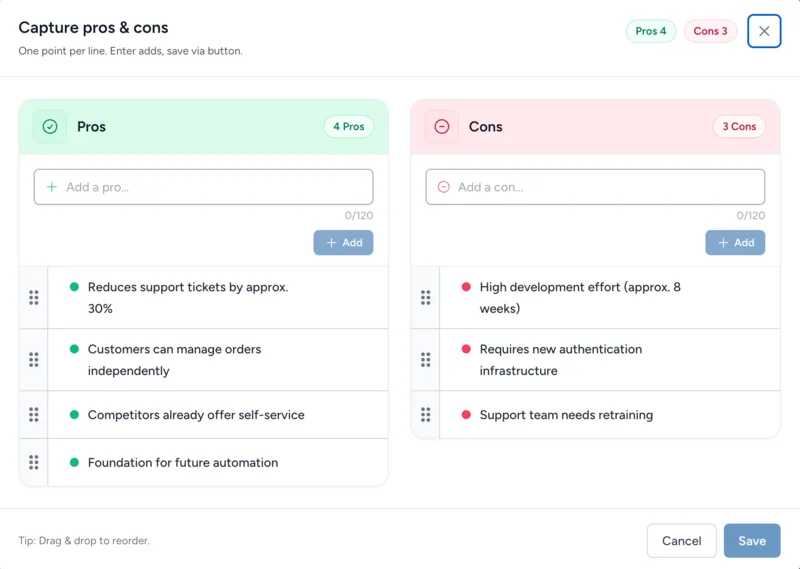
- 1Create a new decision in DecTrack and, for each option, write the main pros and cons directly into the option description. Before inviting the team, run a quick peer review with one colleague to catch missing arguments or lopsided framing.
- 2Invite the team and let them vote on the option anonymously. Anonymous voting stops whichever argument was listed first from anchoring the discussion and makes it visible whether your pros and cons actually persuade.
Try the free interactive tool
Use this method right now in your browser. No signup required, with PDF export.
Frequently asked questions
- There's no fixed number, but aim for at least 3-5 per option. Focus on quality over quantity. One strong, specific argument is worth more than five vague ones.
- A basic Pro/Con list treats all arguments equally. If you need to weight criteria, consider using a Decision Matrix instead, which lets you assign importance scores to each factor.
- Disagreement is healthy. Different perspectives surface arguments you'd miss otherwise. Document all viewpoints, discuss them openly, and let the decision maker or the group vote.
- Pro/Con works best for 2-4 options with qualitative differences. If you have more options or need weighted criteria, use a Decision Matrix. For risk assessment, try Scenario Analysis.
- Yes, and it often works even better remotely. In DecTrack, the decision creator captures all arguments and shares them with the team. Everyone can review and discuss asynchronously before the decision meeting, which leads to more thoughtful input than real-time brainstorming.
Related from the blog
Related methods
SWOT Analysis
Systematically evaluate Strengths, Weaknesses, Opportunities, and Threats for each option. Gives you the full picture before you commit.
Decision Matrix
Score options against weighted criteria for an objective, data-driven comparison. The go-to method for complex decisions with multiple factors.
Scenario Analysis
Think through best case, worst case, and realistic outcomes before you commit. Reduces surprises and prepares your team for different results.