Decision Method
SWOT Analysis for Teams
Evaluate every option from four angles: Strengths, Weaknesses, Opportunities, and Threats. A structured way to uncover risks and potential before you decide.
Last updated: April 2026
What is a SWOT Analysis?
A SWOT Analysis is a strategic planning tool that evaluates a situation across four dimensions: Strengths, Weaknesses, Opportunities, and Threats. Strengths and Weaknesses are internal factors a team can control. Opportunities and Threats are external factors a team can only respond to. Teams use it to align on their position before choosing a strategy.
What makes SWOT more structured than a Pro/Con list is the internal/external distinction. Strengths and Weaknesses are things you control: your team's skills, your technology, your budget. Opportunities and Threats are external: market trends, competitor moves, regulations, economic shifts. This separation forces teams to think about both what they can change and what they must adapt to. A Pro/Con list lumps everything together. SWOT separates what's in your hands from what isn't.
Different team members naturally see different quadrants more clearly. Engineers spot technical weaknesses. Sales sees market opportunities. Leadership identifies strategic threats. Together, the team produces a picture that no individual could create alone. A common extension is the TOWS matrix, which crosses the four quadrants to derive concrete strategies: use strengths to seize opportunities (SO), overcome weaknesses through opportunities (WO), use strengths to counter threats (ST), and minimize weaknesses while avoiding threats (WT). This turns the SWOT from a snapshot into an action plan.
When to use a SWOT Analysis
- You are evaluating strategic options where both internal capabilities and external market factors play a role
- The decision involves market positioning, competitive dynamics, or organizational change
- You want to separate controllable factors (strengths/weaknesses) from uncontrollable ones (opportunities/threats)
- Your team needs to align on both the upside and downside of each option before committing
- You are comparing options that have very different risk profiles and need a structured way to see the differences
- You want a more structured alternative to a simple Pro/Con list that adds the internal/external dimension
Step-by-step guide
- 1
Define what you are analyzing
Pick one option and state clearly what you are evaluating. "Launching a mobile app for our product" is specific enough. "Our company strategy" is too broad. Repeat the SWOT for each option you are comparing. Each option gets its own 4-quadrant analysis. If you only run one SWOT for the company overall, it becomes a strategic review rather than a decision tool.
- 2
Map Strengths (internal, positive)
What internal advantages does this option have? Think about existing resources, team skills, technology, brand reputation, cost structure, customer relationships, and proprietary data. Be specific: "3 engineers with 5+ years cloud experience" is a strength. "Good team" is not. Ask: "What do we do better than anyone else in this space?" Focus on what genuinely differentiates you, not what everyone in the industry also has.
- 3
Map Weaknesses (internal, negative)
What internal gaps or disadvantages exist? Consider missing skills, resource constraints, technical debt, organizational limitations, and process inefficiencies. Be honest. This is the quadrant teams hate filling because it requires admitting problems. Push past the comfortable answers. "We've never done mobile development" is a real weakness that affects the decision. "Room for improvement" is not a weakness, it's avoidance. You can only fix what you name.
- 4
Map Opportunities (external, positive)
What external factors could work in your favor? Look at market trends, emerging technologies, competitor missteps, regulatory changes creating openings, partnership possibilities, and unmet customer needs. Opportunities exist whether you act on them or not. The question is whether this specific decision positions you to capture them. "Competitor just raised prices 30%" is an opportunity. "The market is growing" is too vague to act on.
- 5
Map Threats (external, negative)
What external factors could undermine this option? Consider competitor moves, market saturation, economic downturns, regulatory risks, technology disruption, and supply chain vulnerabilities. Threats are harder to identify because they require looking outside your organization. Ask: "What could go wrong that we have no control over?" Early threat identification lets you prepare contingencies instead of reacting to surprises.
- 6
Cross-reference and decide
Look at the full SWOT for each option. Which option best leverages its strengths against the opportunities, while having manageable weaknesses and survivable threats? Use the TOWS matrix to derive strategies: How can you use Strength X to capture Opportunity Y? How can you fix Weakness A before Threat B hits? The option with the strongest SO combinations and the most manageable WT combinations is usually the winner.
Pro tip: Start with internal factors (Strengths/Weaknesses) before external ones (Opportunities/Threats). Teams find it easier to assess what they control first. Once the internal picture is clear, they spot external factors more accurately because they know what they're measuring against.
Pro tip: Have different departments fill in the quadrants they know best. Engineers are better at identifying technical weaknesses. Sales sees market opportunities. Finance spots financial threats. The combined SWOT from diverse perspectives is far richer than any one person's view.
Pro tip: Keep each quadrant to 3-5 items. Quality beats quantity. A quadrant with 12 items is an unfocused brain dump. A quadrant with 4 specific, well-articulated items drives action. If you have more than 5, consolidate or prioritize.
Pro tip: Don't stop at the SWOT grid. The grid alone is a snapshot. The value comes from deriving TOWS strategies: Which strengths can capture which opportunities? Which weaknesses need fixing before which threats arrive? Without this step, the SWOT sits in a slide deck and helps no one.
Example
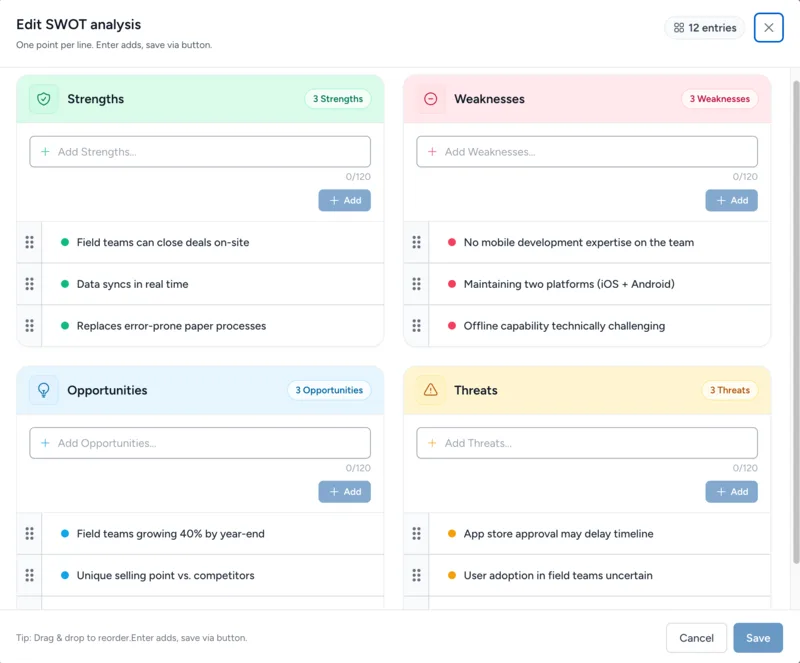
A SaaS company is evaluating whether to build a mobile app for their existing web product.
Option: Build a Native Mobile App
Strengths
- Strong existing user base wanting mobile access
- Experienced development team
- Well-documented API ready for mobile integration
Weaknesses
- No mobile development experience on the team
- Limited budget for two platforms (iOS + Android)
- Current UI is not optimized for small screens
Opportunities
- Competitors don't have mobile apps yet
- Mobile usage in target market growing 40% YoY
- Push notifications could boost engagement
Threats
- App store approval process could cause delays
- Users expect native performance and UX
- Maintaining two codebases increases complexity
Worked Example
A mid-size German Maschinenbau company (120 employees) is evaluating whether to enter additive manufacturing (industrial 3D printing). The strategy team ran a SWOT with department heads from Engineering, Sales, Finance, and Operations.
| Strengths (Internal +) | Weaknesses (Internal -) |
|---|---|
| 40 years of precision manufacturing expertise | No in-house 3D printing experience or equipment |
| Existing customer base of 200+ industrial clients | Limited R&D budget (3% of revenue vs 8% industry average for AM players) |
| Strong brand reputation in DACH region for quality | Sales team trained for traditional RFQ process, not consultative AM selling |
| ISO 9001 certified production processes | Current ERP system cannot handle AM-specific job costing |
| Opportunities (External +) | Threats (External -) |
| AM market growing 25% annually in DACH industrial segment | Three pure-play AM competitors already active in our customer segment |
| Two major customers asked about AM capabilities in last 6 months | Technology evolving rapidly, risk of investing in wrong process/material |
| German government offering 30% R&D subsidies for Industry 4.0 | Regulatory uncertainty around AM parts certification in our segments |
| Competitor Firma Weber exited AM due to quality issues, creating opening | Economic slowdown could reduce customer appetite for new technology |
The TOWS combination exercise was the turning point. Pairing the internal strength 'Deep engineering expertise in precision manufacturing' with the external opportunity 'Growing demand for customized small-batch parts' produced a concrete strategy: offer 3D-printed prototype services to existing customers first, using the established trust relationship to test the market without cold outreach. The SWOT alone would have produced a list. The TOWS pairing produced a launch plan.
SWOT Analysis vs Force Field Analysis
| Dimension | SWOT Analysis | Force Field Analysis |
|---|---|---|
| What it maps | 4 quadrants: strengths, weaknesses, opportunities, threats | 2 sides: driving forces vs restraining forces |
| Internal/External | Yes (strengths/weaknesses = internal, opportunities/threats = external) | No (forces can be internal or external) |
| Best for | Strategic evaluation of a position or option | Evaluating whether a specific change should proceed |
| Output | 4-quadrant map + TOWS strategy derivation | Balance indicator showing net direction |
| Key question | "What is our position relative to the market?" | "Should we move forward with this change?" |
Use SWOT when you need a broad strategic assessment that separates internal capabilities from external factors. Use Force Field Analysis when you have a specific change proposal and want to know whether the forces in favor are strong enough. SWOT is diagnostic (understand your position). Force Field is decisional (should we act?). Often used in sequence: SWOT first to understand the full picture, Force Field second to evaluate a specific course of action.
Common Mistakes
1 Confusing internal and external factors
Strengths and weaknesses are internal (things you control). Opportunities and threats are external (market, competitors, regulation). Putting a competitor's move under "weaknesses" muddles the analysis because you cannot fix an external factor with internal action. Test each item: "Can we change this through our own actions?" If yes, it's internal. If no, it's external.
2 Being too vague
"Good team" is not a strength. "3 engineers with 10+ years React experience who built the current platform" is. Vague items cannot inform concrete decisions. Every entry should be specific enough that someone outside your team would understand what it means and why it matters.
3 Running SWOT once and never updating
Markets shift, teams change, competitors move, regulations evolve. A SWOT from 6 months ago may no longer reflect reality. Schedule periodic reviews, especially before major decisions. At minimum, update the external quadrants (opportunities/threats) quarterly because those change faster than internal factors.
4 Stopping at the grid without deriving strategies
A SWOT that sits in a presentation helps no one. The value comes from crossing quadrants to generate concrete strategies. Which of your strengths can you use to capture which opportunities? Which weaknesses do you need to fix before specific threats hit? Without the TOWS step, you have a nice diagram and zero action items.
How to do a SWOT Analysis in DecTrack
- 1Create a decision in DecTrack and, for each option, write the Strengths, Weaknesses, Opportunities, and Threats into the option description. Keep every entry concrete with numbers or examples rather than generic labels.
- 2Invite the team to vote anonymously. You quickly see whether colleagues share your SWOT read or whether someone spots a risk or opportunity you missed, before you commit to a direction.
Try the free interactive tool
Use this method right now in your browser. No signup required, with PDF export.
Frequently asked questions
- Pro/Con is simpler: just arguments for and against. SWOT adds structure by separating internal factors (Strengths/Weaknesses) from external ones (Opportunities/Threats). Use SWOT when external market factors play a big role in your decision.
- Yes, and it's worth it. Different team members see different things. Engineers are great at spotting weaknesses, product people see opportunities, and leadership identifies threats. The combined view is far richer than any individual perspective.
- Aim for 3-5 items per quadrant. Too few means you haven't thought deeply enough. Too many makes it hard to prioritize. Focus on the most important factors that would actually influence the decision.
- Yes, and it often works even better. In DecTrack, the decision is shared with the whole team for asynchronous review and discussion, which avoids the loudest voice dominating the session. You get more diverse and honest input.
- Yes. SWOT gives you a qualitative overview. If you want to then compare options quantitatively, feed the SWOT insights into a Decision Matrix where you can weight and score each factor.
Related from the blog
Related methods
Pro/Con Analysis
List arguments for and against each option to create a clear basis for discussion. Ideal when the decision is qualitative and you want the whole team involved.
Decision Matrix
Score options against weighted criteria for an objective, data-driven comparison. The go-to method for complex decisions with multiple factors.
Impact/Effort Matrix
Rate each option by impact and effort to find quick wins and stop wasting resources on low-value work.