Decision Method
Impact/Effort Matrix for Teams
Rate every option by its potential impact and required effort. Find quick wins, identify big bets, and stop wasting time on low-value work.
Last updated: April 2026
What is an Impact/Effort Matrix?
An Impact/Effort Matrix is a prioritization framework that rates each option on two dimensions: how much impact it will have (1-5) and how much effort it requires (1-5). This creates four quadrants that give you a clear action for every item: Quick Wins (high impact, low effort) go first. Big Bets (high impact, high effort) get planned carefully. Fill-Ins (low impact, low effort) fill gaps. Avoid (low impact, high effort) gets dropped.
The framework answers the question every team with limited resources faces: "We have 20 ideas and capacity for 5. Which 5?" Without a matrix, teams default to working on whatever the most senior person suggested or whatever feels most urgent. The Impact/Effort Matrix replaces politics and gut feeling with a visible, shared ranking that the whole team can see and challenge. When a product manager says "but my feature is important," the matrix asks "more important than which other feature, and at what effort cost?"
Product teams, project managers, and agile coaches use this matrix to prioritize backlogs, plan sprints, allocate resources, and cut scope. It is one of the simplest prioritization tools that actually changes behavior, because the visual output makes it impossible to ignore that 30% of your backlog is in the Avoid zone. The matrix is also used under the names Value/Effort Matrix, 2x2 Prioritization Grid, or Priority Matrix.
When to use an Impact/Effort Matrix
- You have a backlog of features, tasks, or ideas and need to decide what to work on first with limited capacity
- The team disagrees on priorities and you need a visual, shared framework to align instead of debating
- You want to identify quick wins that deliver value without draining resources, especially early in a project when momentum matters
- Sprint or quarter planning requires ranking items by return on investment, not just by urgency or seniority
- You need to cut scope and want a rational, defensible way to decide what to drop
- Stakeholders request everything at once and you need a framework to push back with data, not just opinions
Step-by-step guide
- 1
Collect all items
Gather every task, feature, idea, or project the team is considering. Write each one as a short, specific statement. "Improve onboarding" is too vague. "Add interactive walkthrough to onboarding flow" is specific enough to estimate effort and impact. Don't filter yet. The matrix does the filtering for you. Include items that seem obviously low-priority. Sometimes the matrix reveals they're actually quick wins nobody considered.
- 2
Define what impact and effort mean for your context
Before anyone rates anything, agree on what the scales mean. Impact might mean: revenue generated, users affected, risk reduced, strategic goals advanced, or customer satisfaction improved. Effort might include: development hours, cost, dependencies on other teams, risk of the implementation failing, or opportunity cost of not doing something else. Without shared definitions, one person's "high impact" is another person's "nice to have." Spend 5 minutes aligning on this before you start.
- 3
Rate each item independently
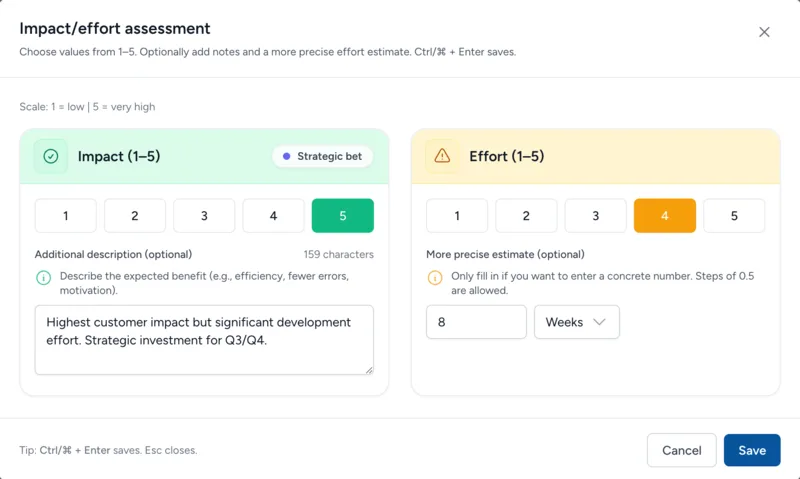
For each item, rate impact (1-5) and effort (1-5) using the sliders. The tool plots them on the matrix automatically. Quick Wins land in the top-left (high impact, low effort). Big Bets in the top-right (high impact, high effort). Fill-Ins in the bottom-left (low impact, low effort). Avoid in the bottom-right (low impact, high effort). Have multiple team members rate independently before comparing. The first rating spoken anchors everyone.
- 4
Review the full picture as a team
Step back and look at the complete matrix. Are there too many items in one quadrant? Are some estimates clearly off? Items that two people rate as Quick Win but one person rates as Avoid deserve discussion. The disagreement usually means people have different information about the effort required or different assumptions about the impact. Resolve these before committing to the prioritization.
- 5
Act on each quadrant
Start with Quick Wins for immediate value and team momentum. Schedule Big Bets with proper planning, realistic timelines, and allocated resources. Use Fill-Ins to keep momentum between larger tasks or when a developer finishes early and needs a small task. Drop or defer anything in the Avoid zone. If a stakeholder pushes an Avoid item, show them the matrix and ask "which Quick Win or Big Bet should we delay to make room?" This turns a political debate into a resource trade-off.
Pro tip: Time-box the rating session to 30 minutes. Quick, gut-level estimates are often more accurate than hour-long analysis because overthinking individual items leads to analysis paralysis. Rate fast, then spend the remaining time discussing the items where team ratings diverged the most.
Pro tip: Use relative ranking, not absolute scores. "Is Feature A higher impact than Feature B?" is an easier question to answer than "On a scale of 1 to 5, what is the exact impact of Feature A?" Compare items to each other, not to an abstract scale. Start by rating one item everyone agrees on, then rate others relative to that anchor.
Pro tip: Revisit quarterly. Effort estimates change as the team learns (something that seemed effort-5 last quarter might be effort-3 now that you've built the foundation). Impact shifts as the market moves (a feature that was impact-5 when customers were demanding it might be impact-2 if a competitor shipped it first). A matrix from last quarter should not drive this quarter's plan.
Pro tip: The Avoid zone is the most important output. Most teams focus on Quick Wins (satisfying) and Big Bets (exciting). But the real productivity gain comes from the Avoid zone: items you stop spending time on. If 30% of your backlog is in Avoid, you've been wasting 30% of your capacity on work that doesn't move the needle. Eliminating that waste is the fastest way to increase team velocity without hiring.
Example
A product team is prioritizing feature requests for the next quarter.
High impact, low effort
High impact, high effort
Low impact, low effort
Low impact, high effort
| Option | Impact | Effort | Quadrant |
|---|---|---|---|
| Add dark mode | 4 | 2 | Quick Win |
| Rebuild onboarding flow | 5 | 4 | Big Bet |
| Update footer design | 1 | 1 | Fill-In |
| Custom reporting engine | 2 | 5 | Avoid |
Worked Example
A product team at a 40-person SaaS company needed to prioritize 12 backlog items for Q3. The PM facilitated a 30-minute session where 4 team members (PM, 2 developers, designer) rated each item independently on impact and effort.
| Item | Impact | Effort | Quadrant | Action |
|---|---|---|---|---|
| Improve onboarding email sequence | 4 | 1 | Quick Win | Do first, week 1 |
| Add SSO login | 3 | 1 | Quick Win | Do first, week 1 |
| Build reporting dashboard | 5 | 5 | Big Bet | Plan for weeks 3-8 |
| Redesign pricing page | 4 | 2 | Quick Win | Do first, week 2 |
| Migrate to new database | 3 | 5 | Avoid | Defer to Q4 |
| Add dark mode | 2 | 2 | Fill-In | Use as buffer task |
| Build API for partner integrations | 5 | 4 | Big Bet | Plan for weeks 4-10 |
| Fix 12 minor UI bugs | 2 | 1 | Fill-In | Sprinkle between big tasks |
| Redesign admin panel | 2 | 4 | Avoid | Defer |
| Add CSV export | 3 | 1 | Quick Win | Do first, week 2 |
| Build mobile app | 4 | 5 | Big Bet | Plan separately, Q4 |
| Improve search performance | 4 | 3 | Big Bet | Plan for weeks 5-7 |
The 'Improve onboarding email sequence' item (impact 4, effort 1) had been in the backlog for 3 quarters without being prioritized. It wasn't technically challenging or exciting, so it always lost to flashier features in sprint planning. The matrix made it impossible to ignore: this item had the highest impact-per-effort ratio of anything on the list. The team shipped it in week 1. Onboarding completion rate increased from 34% to 52% within a month.
Impact/Effort Matrix vs Eisenhower Matrix
| Dimension | Impact/Effort Matrix | Eisenhower Matrix |
|---|---|---|
| Axes | Impact (value delivered) and Effort (resources needed) | Urgency (time pressure) and Importance (goal alignment) |
| What it sorts | Features, ideas, projects for a backlog | Tasks and activities for a person or team |
| Time horizon | This quarter (medium-term planning) | This week (short-term task management) |
| Best for | Product planning, sprint prioritization, resource allocation | Personal productivity, weekly planning, delegation |
| Output | 4 zones: Quick Win, Big Bet, Fill-In, Avoid | 4 categories: Do, Schedule, Delegate, Eliminate |
| Key question | "Is this worth the investment?" | "Should I do this now, later, or not at all?" |
Use the Impact/Effort Matrix for deciding what to build next. "Which features should we prioritize this quarter?" Use the Eisenhower Matrix for managing your time this week. "Which tasks should I work on today?" They work on different time scales: Impact/Effort at the start of each quarter, Eisenhower every Monday morning. You might use both: Impact/Effort to set the quarterly roadmap, then Eisenhower to manage the daily execution of that roadmap.
Common Mistakes
1 Rating everything as high-impact to avoid saying no
If every item is impact 4-5, the matrix provides no differentiation. The purpose of the tool is to make hard trade-offs visible. Some items genuinely have low impact, and rating them honestly is the only way the matrix works. If a stakeholder insists their item is impact 5, ask: "More impactful than which of these other items? What would you drop to make room?"
2 Underestimating effort by forgetting hidden costs
Teams estimate the effort to build a feature but forget: testing time, documentation, training, integration with existing systems, ongoing maintenance, and the opportunity cost of not building something else. A feature that takes 2 weeks to build but 4 weeks to fully integrate, test, and document is an effort-4, not an effort-2. Include the full lifecycle, not just the development sprint.
3 Skipping the quadrant discussion
Rating items is the easy part. The valuable part is the conversation about items where ratings diverge. When the PM rates an item as impact-5 and a developer rates it as impact-2, they have different information or assumptions. The developer might know about a technical constraint that limits the feature's value. The PM might have customer feedback the developer hasn't seen. Skip the discussion and you miss these insights.
4 Treating Quick Wins as less important than Big Bets
Quick Wins are not consolation prizes. They deliver the highest return on investment (high impact per hour of effort). A Quick Win that takes 2 hours and increases conversion by 5% is a better use of time than a Big Bet that takes 200 hours and increases conversion by 15%. Teams that chase Big Bets while ignoring Quick Wins are optimizing for impressiveness, not impact.
How to use the Impact/Effort Matrix in DecTrack
- 1Create a decision in DecTrack and add the options you want to prioritize. Note impact and effort for each option with concrete numbers in the description rather than vague estimates, and place each one into the four quadrants (Quick Win, Big Bet, Fill-In, Avoid) before inviting the team.
- 2Invite the team to vote anonymously so each member rates impact and effort independently. Options with large disagreement between votes are a clear signal that the estimate needs to be clarified before you commit resources.
Try the free interactive tool
Use this method right now in your browser. No signup required, with PDF export.
Frequently asked questions
- An Impact/Effort Matrix uses exactly two fixed dimensions (impact and effort) for quick prioritization. A Decision Matrix lets you define any number of custom criteria with different weights. Use Impact/Effort for fast prioritization, and a Decision Matrix for complex, high-stakes comparisons.
- Use relative comparisons rather than absolute numbers. Ask: 'Compared to option A, is option B higher or lower impact?' Having multiple team members rate independently also smooths out individual estimation errors.
- Usually, yes. Quick Wins build momentum, deliver value fast, and free up resources. Tackle Big Bets in parallel with proper planning, but don't delay Quick Wins waiting for the perfect Big Bet plan.
- It's ideal for remote teams. Share the analysis and collect feedback via the discussion channel. The visual quadrant makes prioritization discussions fast and clear, even asynchronously.
- Revisit quarterly or whenever priorities shift. Impact and effort estimates change as you learn more. An option that was a Big Bet last quarter might become a Quick Win after you've built supporting infrastructure.
Related from the blog
Related methods
Decision Matrix
Score options against weighted criteria for an objective, data-driven comparison. The go-to method for complex decisions with multiple factors.
Pro/Con Analysis
List arguments for and against each option to create a clear basis for discussion. Ideal when the decision is qualitative and you want the whole team involved.
Scenario Analysis
Think through best case, worst case, and realistic outcomes before you commit. Reduces surprises and prepares your team for different results.