Decision Method
Scenario Analysis for Teams
Think through best case, worst case, and realistic outcomes before you commit. Stop betting on a single prediction and prepare your team for the range.
Last updated: April 2026
What is a Scenario Analysis?
Scenario Analysis is a decision-making method where you describe three possible outcomes for each option: the best case (everything goes right), the worst case (everything goes wrong), and the most likely case (realistic expectation). Instead of betting on a single prediction, you prepare for a range of outcomes. This makes your team more resilient because you've already thought through what to do when things don't go as planned.
The method is especially valuable when uncertainty is high and the team is overconfident or overly pessimistic about an option. Teams naturally gravitate toward optimism in planning sessions, which means they underestimate the worst case and overestimate the best case. By writing out all three scenarios explicitly, you force a more balanced assessment. The best case prevents cynicism. The worst case prevents recklessness. The likely case grounds the discussion in reality.
Scenario Analysis is used in corporate strategy, product management, investment analysis, and military planning. Financial analysts use it routinely under the names "sensitivity analysis" or "scenario modeling." The output is not a single prediction but a range that helps the team decide whether the upside justifies the downside. If you can live with the worst case and the likely case is good enough, the decision is safe to proceed.
When to use Scenario Analysis
- Before committing significant resources to a project, market entry, or initiative where the outcome is uncertain
- When the team is overconfident about an option and nobody has considered what happens if it fails
- When the team is too pessimistic and needs to see that even the worst case might be survivable
- When you want to prepare contingency plans for different outcomes rather than just hoping for the best
- When the worst-case scenario could be very costly, irreversible, or damaging to reputation
- When you need to communicate risks and opportunities to stakeholders who need to understand the range of possible outcomes
Step-by-step guide
- 1
Define the option clearly
State what you are evaluating and be specific about scope, timeline, and what "going forward" means. "Launch the premium tier in Q3 with 3 new features" is analyzable. "Grow the business" is not. Each option gets its own set of three scenarios. If you are comparing multiple options, run the analysis for each one separately and compare the scenarios side by side.
- 2
Write the Best Case
What happens if everything goes right? Think about ideal market conditions, flawless execution, and favorable external factors. Be specific about outcomes: revenue numbers, user counts, timeline achievements, cost savings. Don't write "it goes well." Write "we sign 15 enterprise clients in the first 6 months, generating 450k ARR, because our launch coincides with the competitor's pricing increase." Specificity makes the scenario testable later.
- 3
Write the Worst Case
What happens if everything goes wrong? Consider technical failures, market rejection, competitive moves, resource constraints, team conflicts, and external shocks. Be honest about the real downside, not the comfortable version. "We spend 6 months and 200k building a feature nobody wants because our market research missed a shift in buyer priorities" is a useful worst case. "It doesn't work as well as hoped" is not.
- 4
Write the Likely Scenario
What will most probably happen given what you know today? Account for typical delays, average market response, realistic team capacity, and known unknowns. This is the scenario where things mostly work but not perfectly. Timelines slip by 3 weeks instead of 3 months. Adoption reaches 60% of target instead of 100% or 10%. Most decisions play out in this middle zone, so this is the scenario your plan should be built for.
- 5
Compare and decide
For each option, look at all three scenarios. Can you survive the worst case? Is the likely scenario good enough to justify the investment? Is the best case worth the risk? Compare across options: which option has the most manageable worst case, the strongest likely scenario, and the most attractive best case? The option with the best balance of upside potential and survivable downside is usually the right choice.
Pro tip: Write the worst case first. Teams naturally gravitate toward optimism, so starting with "what if everything fails?" produces more honest assessments across all three scenarios. If you start with the best case, the worst case becomes "the best case but slightly less good" instead of a genuinely bad outcome.
Pro tip: Add a trigger to each scenario. "What specific event or metric would tell you this scenario is unfolding?" For the worst case: "If we have zero signed deals after 3 months." For the best case: "If pipeline exceeds 500k after month 2." Triggers turn scenarios from thought experiments into an early warning system.
Pro tip: Challenge the likely scenario hardest. The best case and worst case are easy to write because they are extremes. The likely scenario is where lazy thinking hides. Teams often write a "slightly optimistic" likely scenario that is actually their best case in disguise. Push for realism: what happened last time you did something similar?
Pro tip: Use Scenario Analysis for the options, not for the decision itself. Don't write best/worst/likely for "should we expand?" Write it for "Option A: expand with a full team" and separately for "Option B: expand with one sales rep." Comparing scenario ranges across options is far more useful than analyzing a single option.
Example
A startup is evaluating whether to expand into a new market segment.
Best Case
Strong product-market fit from day one. First enterprise client signs within 6 weeks. Revenue from new segment covers development costs within 4 months. Team morale spikes from early success.
Worst Case
New segment requires major product changes not anticipated. Sales cycle is 6x longer than core market. After 6 months, only 2 trial users, no paying customers. Team is stretched thin, core product quality suffers.
Likely Scenario
Product needs moderate adjustments for the new segment. First paying customer after 3 months. Break-even on development costs after 8 months. Some distraction from core product but manageable with clear priorities.
Worked Example
A B2B SaaS company with 30 employees is deciding whether to expand into the US market. The CEO ran a Scenario Analysis with the leadership team to move beyond "we should go for it" vs "it's too risky."
| Dimension | Best Case | Likely Case | Worst Case |
|---|---|---|---|
| Revenue Year 1 | 500k USD (8 enterprise deals) | 200k USD (3 enterprise deals) | 50k USD (1 small deal) |
| Investment | 300k USD (team + infrastructure) | 300k USD (same regardless) | 300k USD (same regardless) |
| Break-even | Month 7 | Month 14 | Never (withdraw after 18 months) |
| Market position | Established player in US segment | Small foothold with growth path | Retreated, refocused on DACH |
| Team impact | Energized, attracted US talent | Stretched but managing | Burned out, 2 people leave |
The worst case scenario included "2 people leave" which the CEO hadn't considered. When you stretch a 30-person team to cover a new market while maintaining the existing one, the people risk is often the worst consequence, worse than the financial loss. The Scenario Analysis surfaced this by requiring explicit thought about team impact, not just revenue.
Scenario Analysis vs Premortem
| Dimension | Scenario Analysis | Premortem |
|---|---|---|
| Focus | Range of outcomes (best, likely, worst) | Single outcome: failure. What caused it? |
| Perspective | Forward-looking: "What could happen?" | Backward-looking: "It already happened. Why?" |
| Output | Three scenario descriptions + expected value | Prioritized failure list + action plan |
| Optimism | Includes best case (balances pessimism) | Only considers failure (designed to counter optimism) |
| Best for | Investment decisions, market entry, resource allocation | Project kickoffs, risk prevention, team alignment |
Use Scenario Analysis when you need to evaluate whether the upside justifies the risk across a range of outcomes. Use a Premortem when you need to discover hidden risks by forcing the team to imagine failure. They complement each other: Scenario Analysis shows the range, Premortem digs deep into the worst end of that range. For high-stakes decisions, do both.
Common Mistakes
1 Making the worst case too comfortable
"Revenue is lower than expected" is not a worst case. A real worst case includes financial loss, sunk costs, team burnout, opportunity cost of what you didn't do instead, and reputation damage if the initiative fails publicly. Teams soften the worst case to avoid discomfort, which defeats the purpose of writing it in the first place.
2 Ignoring the likely scenario
Teams spend all their energy debating the best and worst cases, then rush through the likely scenario. But 60-70% of outcomes land in the likely zone. Your plan should be built for this scenario, with contingencies for the others. The likely scenario deserves the most detail and the most honest assessment.
3 Not assigning probabilities
Without probabilities, the three scenarios are just stories. Even rough estimates (best: 15%, likely: 65%, worst: 20%) allow an expected value calculation that turns stories into numbers. You don't need precision. You need a reasonable split that forces the team to acknowledge how likely each outcome really is.
4 Analyzing a single option instead of comparing
Scenario Analysis is most powerful when you compare the scenario ranges of multiple options. "Option A's worst case is -300k but its likely case is +200k. Option B's worst case is -80k and its likely case is +120k." Now you can see the risk-return trade-off. Analyzing one option in isolation tells you less.
How to do Scenario Analysis in DecTrack
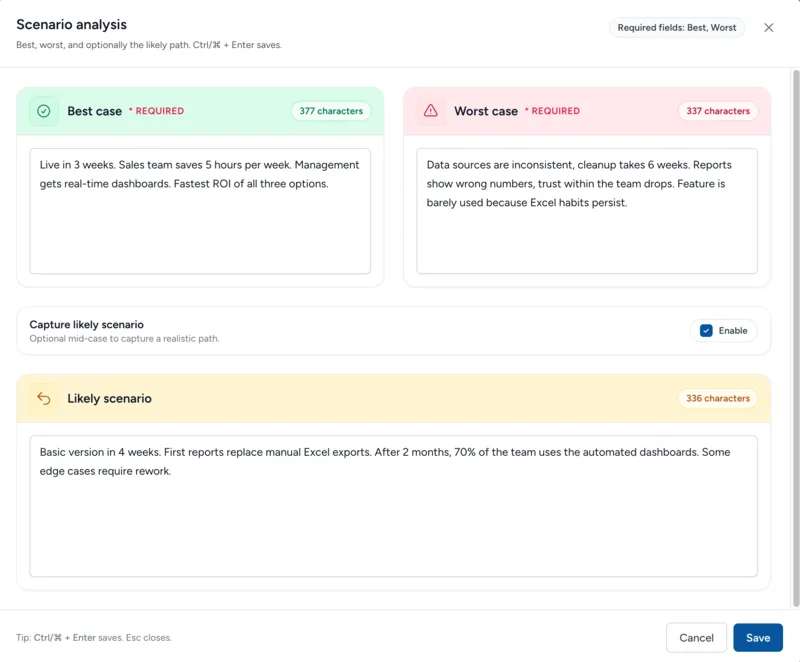
- 1Create a new decision in DecTrack and add the options you want to compare. For each option, write the Best Case, Worst Case, and Likely Scenario into the option description with concrete, measurable outcomes, and spell out the assumptions behind each scenario.
- 2Invite the team to vote anonymously. The most useful signal is when an option has the highest best case but a worst case the company could not survive. Those options surface in the vote and can be ruled out deliberately before you commit.
Frequently asked questions
- 2-4 sentences per scenario is enough. Focus on specific, measurable outcomes (revenue, timeline, user numbers) rather than vague descriptions. The goal is to make each scenario concrete enough to evaluate.
- Good. Different team members may have different risk assessments based on their experience. Document both versions and discuss which assumptions are more realistic. This often reveals hidden risks.
- You can, but it's not required. If you do, a common split is: Best Case 10-20%, Likely Scenario 60-70%, Worst Case 10-20%. The main value is in thinking through the scenarios, not in the exact probabilities.
- Yes. In DecTrack, the scenarios are captured and shared with the team. Asynchronous discussion often produces more diverse perspectives than a live workshop. The written format also creates useful risk documentation.
- For low-risk, easily reversible decisions, a simple Pro/Con list is faster and sufficient. Scenario Analysis shines when the decision is hard to reverse, involves significant resources, or has high uncertainty.
Related from the blog
Related methods
Pro/Con Analysis
List arguments for and against each option to create a clear basis for discussion. Ideal when the decision is qualitative and you want the whole team involved.
SWOT Analysis
Systematically evaluate Strengths, Weaknesses, Opportunities, and Threats for each option. Gives you the full picture before you commit.
Impact/Effort Matrix
Rate each option by impact and effort to find quick wins and stop wasting resources on low-value work.